
Today is the 8th anniversary of my late husband’s passing. I have been reflecting on the stages of my experience with grief: shock, pain, despair, anger, bitterness, healing, rebuilding, and redemption. I have come so far in my story, but I have not detached the room in my heart for Jon. I don’t visit it as often as I used to. The memories are collecting dust. Some have lost their shape altogether. I have started working on my book again, which requires me to revisit and relive those early experiences.
This process has led me on a quest to understand the nature of suffering on a theological and philosophical level. I am by no means an expert, but on this day of remembrance, I want to share this part of my journey with those of you who have followed along over the years. Please know that no one no matter how wise, no one can tackle this topic in one blog post. I cannot possibly unpack every nuance. This post is essentially a summary of my personal conclusions on a topic that is complex and by nature.. triggering to many. I hope it helps you form your own questions to wrestle with on the journey toward finding peace amidst life’s suffering.
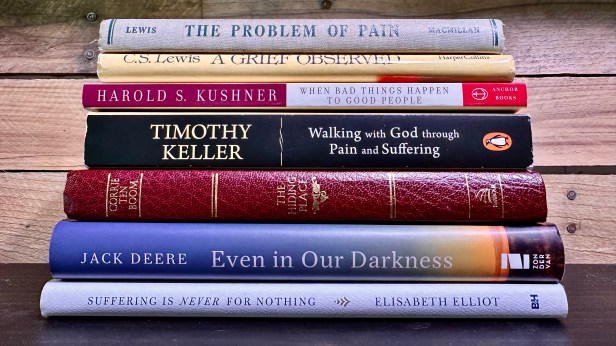
For some time, I struggled with how there could be a good God when so much pain exists. This struggle is not unique to me. Over the last thousand years, scholars and theologians much smarter than me have explored and debated this topic. But for me, it really came to a head when my friend lost her baby girl not long after I lost my husband. I raged at God on her behalf as well as my own. How could He be so cruel? Maybe the God I grew up with did not exist at all.
Then it occurred to me: If there is no God, where did this outrage come from?
If we are just intelligent animals doing our best to exist on this miserable space rock, then the death of a child would simply be the survival of the fittest. Suffering and compassion have no meaning in the animal world. The slightest sign of blood on a chicken will have it viciously pecked to death by its flock. When a wolf pack sees a member too old, sick, or injured to hunt, it gets left behind. While there are some rare examples of altruism in the animal kingdom (particularly among dolphins and whales), the general truth is when a creature no longer can contribute to the social group or a baby is born weak or sick, it is killed or abandoned. (See Also NatureIsMetal on Instagram.. if you can stomach it.)
But across culture, religion, and history, the death of a child, be it due to sickness or violence, feels instinctively wrong. To me, the very instinct that made me question God’s goodness was in itself evidence of a God that is good. The fact that I hunger for a world without suffering makes me believe that I was made for a world without suffering. My father has ducks, and they LOVE being in water. If he were to take their pools out of their run, they would splash in their water bucket. They were made for a world with water everything in them desires it. We are made for Eden, for perfection, harmony, and eternity. Like ducks devoid of water we constantly feel something isn’t right in our world.
In Tim Keller’s book on suffering he says that during hardship, a vague belief in God is worse than no belief in God. What good is a generic god who asks nothing of us and just wants us to be good (according to our own interpretations) and feel happy? How does that god help in the face of trauma? It can offer no explanation or consolation. To endure one needs pragmatic Darwinism that brings resignation to the cruelty of nature or a robust system of faith that brings hope that there is more than this physical world at work.
The topic of suffering and the Christian faith always finds itself back in Genesis. Whether you believe it to be historical or poetical, it boils down to humans using their gift of free will to sever our connection with God. They ripped what was whole and introduced the empty space that is evil and suffering. Much of the turmoil we face can be directly linked to the misuse of free will. War, abuse, and oppression all find their roots in human hearts. The current state of climate and environmental crisis is the result of our collective choice to plunder rather than steward the Earth. We have enough food to feed the planet’s children, we have just decided not to. Even my late husband’s genetic heart condition, I attribute to the result of our fallen world. I do not believe that God goes around zapping random babies with infirmities. I do not believe God has a hand in destruction (John 10:10). These things happen as a natural course of the world that is still being redeemed. Unless the suffering is a direct consequence of someone’s own actions, I don’t believe it “happens for a reason”. Sometimes bad things just happen.
I no longer struggle with why suffering exists because I have made peace that it exists. A pastor I know once said that he had no room in this theology for suffering. This is a complete denial of scripture and the world we live in. To ignore the experience of suffering is to ignore (or worse, blame) the people experiencing it and fail to prepare oneself for its inevitable appearance. Try as we might, we cannot educate, medicate, or legislate ourselves out of a suffering world. This does not mean we should not continue to fight hard against preventable suffering and those who perpetrate it! We can and should use all of our resources to make a better world within our area of influence. But accidents happen, companies go under, hurricanes hit. Trying to avoid all suffering is like running from your own shadow. You may not see it all of the time, but it shouldn’t be strange when you do.
The God I believe in is the mender of hearts, the restorer of lives. He became one of us and filled the hole we ripped with his suffering body. Through Him we not only have access to supernatural strength and endurance for our own trials but the ability and obligation to follow his example and come alongside and ease the suffering of others. In fact, I believe that is the primary way to honor God. I’m rereading the Old Testament and I have lost count of how many times there are explicit instructions to take care of the powerless and hurting (widows, orphans, and immigrants). In the New Testament, it is referred to as half the equation of perfect religion. If your theology doesn’t move you to take care of the hurting, your theology is incomplete.

I’d like to end this post with two questions and a poem.
1. What mental and/or spiritual resources can you cultivate to prepare your heart to embrace the human experience of suffering for yourself and others? Build deeper community? Start therapy? Return to your faith? Read biographies of overcoming?
2. Whose suffering is it in your power to relieve today? This week? This year? Can you take in foster kids? Cook meals for a single mom? Mow the lawn of a sick neighbor? Buy an umbrella for the man begging on the street corner? Teach the fatherless neighbor kids how to change a tire?
We cannot pray to You, O God,
to banish war,
for You have filled the world
with paths to peace,
if only we would take them.
We cannot pray to You
to end starvation,
for there is food enough for all,
if only we would share it.
We cannot merely pray
for prejudice to cease,
for we might see
the good in all
that lies before our eyes,
if only we would use them.
We cannot merely pray
“Root out despair,”
for the spark of hope
already waits within the human heart,
for us to fan it into flame.
We must not ask of You, O God,
to take the task that You
have given us.
We cannot shirk,
we cannot flee away,
Avoiding obligation for ever.
Therefore we pray, O God,
for wisdom and will, for courage
to do and to become,
not only to look on
with helpless yearning
as though we had no strength.
For Your sake and ours
speedily and soon, let it be:
that our land may be safe,
that our lives may be blessed.
Rabbi Jack Riemer
 Erica Roman Blog
Thanks for sharing your thoughts so far on reconciling the pain of this life with the goodness of God. I always appreciate your perspective and hope you continue to find time to write about your journey.
LikeLike